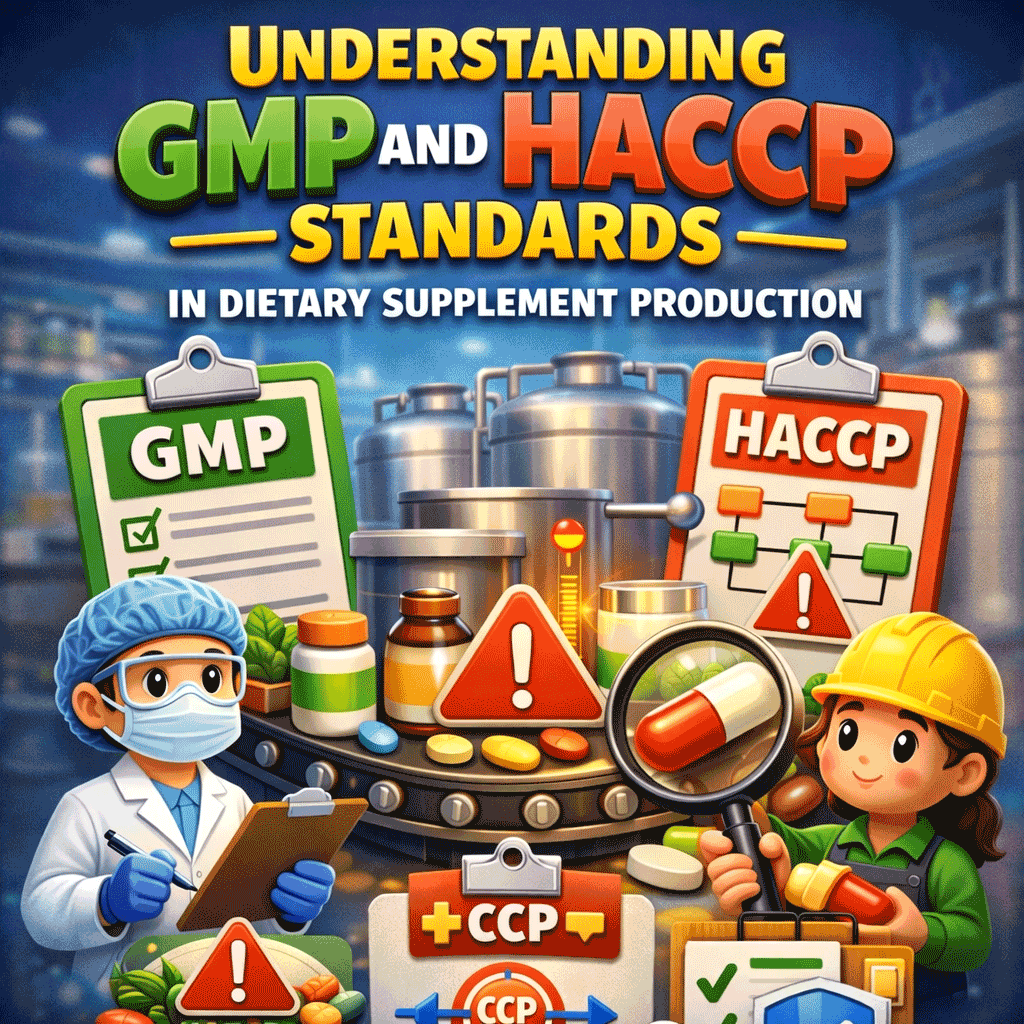
GMP Supplement Manufacturing and Its Role in Dietary Supplement Quality
What GMP Means in Dietary Supplement Production
Good manufacturing practices are a structured system designed to ensure safety and quality throughout the manufacturing process. In gmp supplement manufacturing, GMP refers to the control of personnel, facilities, equipment, materials, documentation, and production conditions to prevent contamination, errors, and deviations.
In the dietary supplement industry, GMP is essential for producing products that consistently meet specifications. GMP establishes standardized procedures so that the final product remains safe, effective, and compliant across every batch. Without GMP, even a well-designed formulation can fail due to uncontrolled production variables.
GMP is not only about compliance. It reflects a company’s commitment to product safety and quality, ensuring that supplements are produced under controlled conditions that protect both the product and consumers.
How GMP Applies to Food and Food Supplements
Dietary supplements are regulated as food and not as pharmaceutical products. This distinction has important implications for manufacturing. Food and food supplements must comply with food safety requirements rather than drug approval processes, but this does not mean lower standards.
- GMP requirements for food and dietary supplement production include:
- Qualified and trained personnel
- Hygienic premises and controlled environments
- Suitable equipment designed to prevent contamination
- Clear documentation and record-keeping
- Defined procedures for production and packaging
In gmp supplement manufacturing, these controls ensure that hazards are minimized before they become safety risks. GMP creates the operational discipline required for consistent quality assurance.
HACCP as a Food Safety System in Dietary Supplement Manufacturing
The Purpose of HACCP in Food and Supplement Production
The HACCP system is a preventive food safety approach designed to identify, evaluate, and control hazards that could affect the safety of food products. In dietary supplement production, HACCP focuses on hazard analysis rather than end-product testing alone.
Hazard analysis is essential because many risks cannot be detected by testing the finished product. Contamination, incorrect dosage of active ingredients, or cross-contact may occur during the production process and must be controlled proactively.
The purpose of the haccp plan is to ensure that potential hazards are identified and kept under control at specific points in the production process. This approach protects product safety while supporting efficient manufacturing.
The Relationship Between GMP and HACCP
GMP and HACCP are closely connected systems. GMP provides the foundation, while HACCP builds on that foundation with targeted risk control.
Without good manufacturing practices, the haccp system cannot function effectively. GMP ensures that the facility, equipment, and personnel are suitable for food production. HACCP then focuses on hazard analysis and critical control points within that controlled environment.
In practice:
GMP controls general conditions
HACCP controls specific hazards
Together, they form a comprehensive system designed to ensure safety and quality in the supplement industry.
Understanding Critical Control Points (CCPs) in Supplement Production
Identifying Critical Control Points in Dietary Supplement Manufacturing
Critical control points (CCPs) are steps in the manufacturing process where control is essential to prevent, eliminate, or reduce food safety hazards to acceptable levels. CCPs are identified through hazard analysis and critical evaluation of the production process.
Not every step is a CCP. CCPs are distinct from general process controls because failure at a CCP can directly affect product safety.
Examples of critical control points in dietary supplement production include:
- Raw material acceptance
- Weighing and dispensing of active ingredients
- Mixing and blending steps
- Encapsulation or tableting
- Packaging and labeling
- Each CCP must be clearly defined in the haccp plan to ensure effective control.
Setting Critical Limits at CCPs
Critical limits are measurable criteria that determine whether a CCP is under control. Critical limits may include time, temperature, weight, concentration, or physical parameters.
For example:
Maximum deviation allowed in active ingredient weight
Temperature limits during processing
Moisture levels during storage
Critical limits help ensure the safety of food by defining acceptable operating conditions. When a critical limit is exceeded, immediate action is required to protect the final product.
Corrective Actions and Monitoring Under HACCP Systems
Monitoring Critical Control Points
Monitoring is the routine measurement or observation of CCPs to ensure that critical limits are consistently met. Monitoring activities must be defined in the haccp plan and carried out by trained personnel.
Effective monitoring:
Detects deviations early
Supports quality assurance
Provides documented evidence of control
Monitoring records are essential for demonstrating compliance to regulators, third party auditors, and customers.
Corrective Actions When Critical Limits Are Exceeded
Corrective actions are predefined steps taken when monitoring indicates a deviation from critical limits. Corrective actions must address both the immediate issue and its root cause.
Typical corrective actions include:
Isolating affected product
Adjusting the production process
Investigating the cause of deviation
Preventing recurrence
Timely corrective actions protect product safety and maintain trust with consumers.
Developing a HACCP Plan for Dietary Supplement Production
The Seven Principles of HACCP
The haccp system is based on the seven principles that guide hazard analysis and control:
Conduct hazard analysis
Identify critical control points
Establish critical limits
Establish monitoring procedures
Establish corrective actions
Establish verification procedures
Establish documentation and record keeping
These seven principles form the structure of every haccp plan.
The Steps Involved in Developing a HACCP Plan
Developing a haccp plan involves a structured process:
Describe the product and its intended use
Develop a flow diagram of the production process
Conduct hazard analysis at each step
Identify CCPs and critical limits
Define monitoring and corrective actions
The plan must be designed to ensure the safety of the product throughout the production and packaging stages.
Hazard Analysis and Critical Control in the Manufacturing Process
Types of Potential Hazards
Hazard analysis focuses on identifying potential hazards that may affect product safety. These hazards typically fall into three categories:
| Hazard Type |
Example in Supplement Production |
| Biological |
Microbial contamination |
| Chemical |
Incorrect dosage of active ingredients |
| Physical |
Foreign material contamination |
Understanding hazards is essential for effective hazard analysis and critical control.
Hazard Analysis and Food Microbiology
Food microbiology plays a key role in hazard analysis for dietary supplements. While many supplements are dry products, microbial risks may still arise from raw materials, moisture exposure, or improper handling.
The haccp plan must address microbiological hazards where applicable, especially in products with higher moisture content.
Quality Assurance and Verification
Verification of the HACCP System
Verification activities confirm that the haccp system is functioning as intended. Verification may include internal audits, review of records, and validation of control measures.
Verification ensures that:
CCPs are properly controlled
Monitoring is effective
Corrective actions are adequate
The Role of Third Party Audits
Third party audits provide independent verification of GMP and HACCP compliance. These audits support credibility in the marketplace and demonstrate commitment to product safety.
Audits are not only a regulatory expectation but also a competitive advantage in the supplement industry.
Why GMP and HACCP Are Essential for Food Safety and Consumers
Protecting Food Safety Throughout the Supply Chain
From raw materials to the finished product, GMP and HACCP work together to reduce contamination risks. These systems ensure that every step of production remains under control.
By applying hazard analysis and critical control principles, manufacturers can prevent issues rather than reacting to failures after production.
Building Trust With Regulators and Consumers
In a competitive market, trust is essential. Compliance with GMP and HACCP demonstrates responsibility, transparency, and commitment to safety and quality.
Consumers rely on dietary supplements for health support. Protecting consumers means protecting the long-term sustainability of the business.
Conclusion
GMP and HACCP are not optional systems in dietary supplement production. They are essential frameworks designed to protect food safety, ensure quality assurance, and safeguard consumers.
Understanding hazard analysis, critical control points, critical limits, monitoring, and corrective actions allows manufacturers to build robust systems that support compliance and competitiveness. In the dietary supplement industry, strong GMP and HACCP implementation is the foundation of long-term success and consumer trust.